

Choosing the Right AI Model for Business Integration
The best AI model for a business use case is rarely the most powerful one. It is the one that fits the workflow, the data, and the reliability requirement.
AI integration, model evaluation, and workflow design
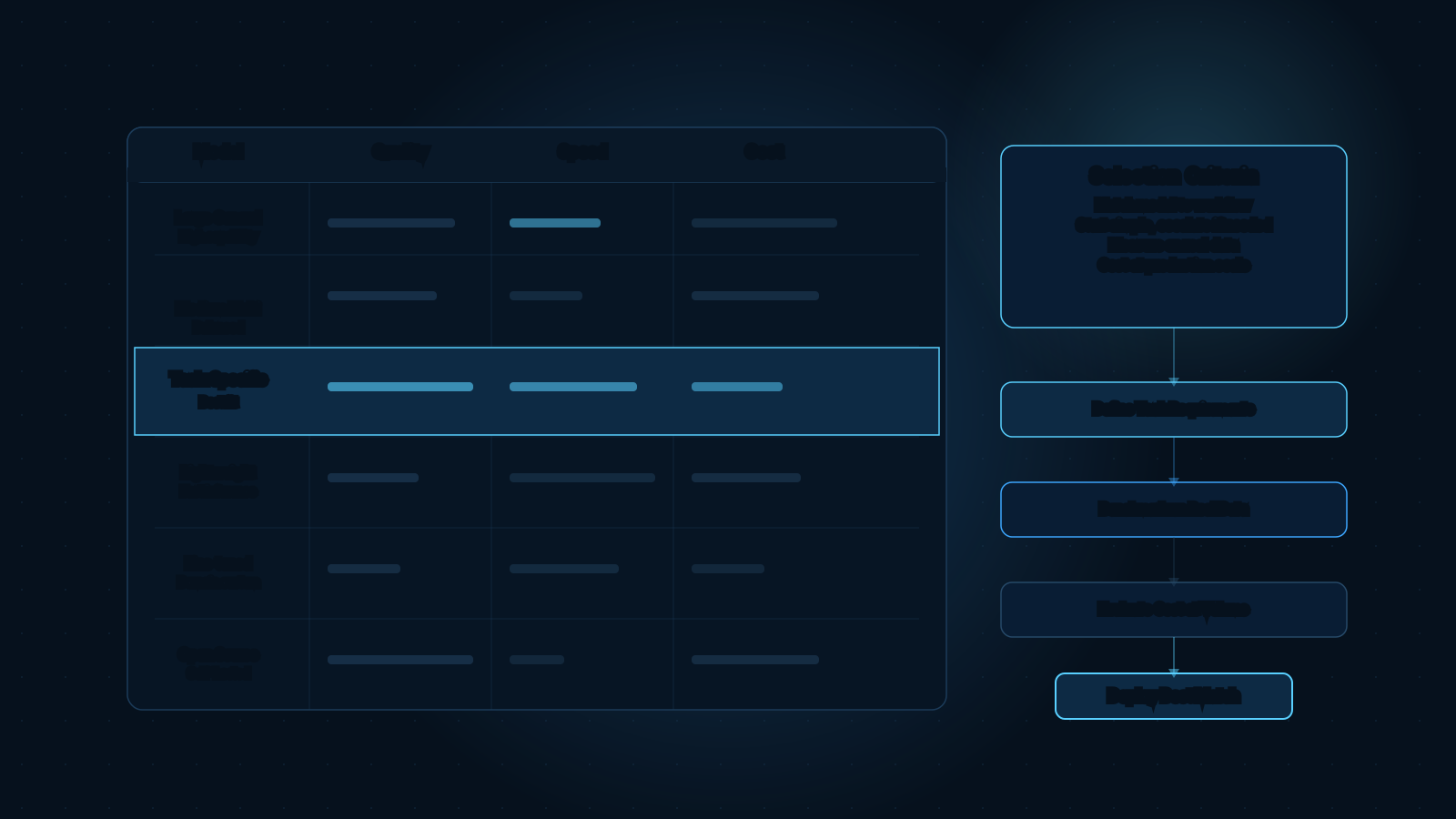
Businesses evaluating AI integration often start by comparing model capabilities on public benchmarks. That comparison is useful for research but misleading for business decisions. The right model depends on the specific use case, the data environment, the latency requirement, and the cost structure of the workflow it will support.
Smaller, faster models often outperform larger ones in production when the task is well-defined and the expected output format is clear. A classification task, a structured extraction job, or a triage step does not need the most general-purpose model available. It needs one that is reliable, fast, and affordable at the volume the business requires.
Cost is an underappreciated factor in model selection. A model that costs ten times more per request may produce marginally better output on edge cases while significantly increasing the operating expense of an integration that runs thousands of times per day. Understanding the cost curve before committing to a model prevents surprises after deployment.
The practical recommendation is to start with the simplest model that meets the quality bar for the specific task, measure its performance on real data, and only escalate to a more capable model if the simpler one falls short in ways that matter to the business. This approach reduces cost, improves speed, and keeps the integration manageable.
Continue with adjacent thinking.
Related articles are selected by category alignment first, then by overlapping tags and editorial fit.
AI Integration Beyond Chatbots
The most valuable AI work often happens behind the interface, inside the workflow itself.
AI Agents Are Not the Problem. Deployment Is.
Every major company is racing to deploy AI agents. Most will sit idle within six months. The failure is not technical.
Practical AI Governance for Companies Moving Beyond Experiments
AI governance becomes real when teams need clearer control over data, usage boundaries, review, and operational responsibility.
Contact
If this perspective matches a live delivery problem, email the context and we will respond with a clear next step.
Email info@cylunor.com. We review the context, confirm fit, and respond within one business day with either follow-up questions or a clear next step.