

AI Agents Are Not the Problem. Deployment Is.
Every major company is racing to deploy AI agents. Most will sit idle within six months. The failure is not technical.
Software systems, practical AI, and digital delivery thinking.
Venture capitalists poured $242 billion into AI companies in the first quarter of 2026 alone. Every major enterprise has an AI agent announcement. BNY Mellon is deploying 20,000 agents. Atlassian is cutting staff to fund AI. The headlines suggest a transformation already underway. The reality inside most organisations is quieter and considerably messier.
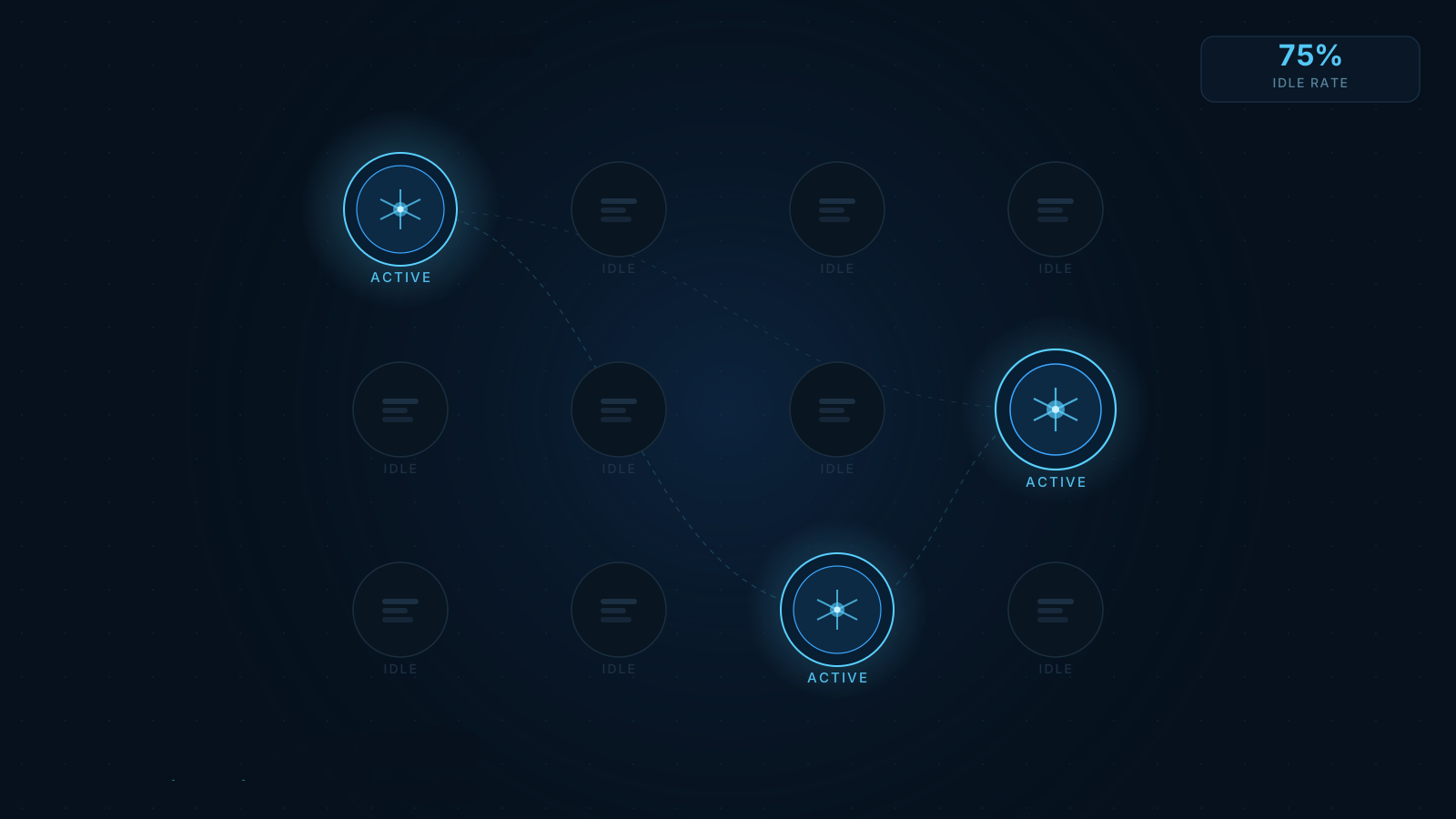
The agents are being deployed. Most of them will not be used six months from now. This is not a prediction - it is already happening in the companies that moved fastest. The failure is not a model problem. The models are capable. The failure is a deployment problem, and it is almost entirely avoidable.
The core mistake is designing agents around what AI can do rather than around what the business actually needs. A capable model gets pointed at a process, produces impressive outputs in a demo environment, and gets shipped. Then it meets reality: inconsistent input data, unclear ownership, no feedback loop, and users who were never genuinely consulted. Within weeks, teams route around it. Within months, no one can remember why it was built.
Process clarity is the precondition that almost no one talks about. An AI agent cannot reliably automate a process that no one has clearly defined. If the steps are ambiguous, the decision criteria are undocumented, or the expected output is inconsistently understood, the agent will produce inconsistently understood output. The problem existed before the agent. The agent makes it visible faster.
Data quality is the second constraint. The organisations seeing real returns from AI agents are not necessarily the ones with the most advanced models. They are the ones whose underlying data is clean, structured, and consistently maintained. Bad data in produces bad decisions out, at machine speed. An agent running on poor data is not a productivity tool - it is an error amplifier.
Ownership is the third failure point. Successful AI agent deployments have a named person responsible for outcomes, a clear escalation path when the agent produces wrong results, and a defined review cadence. When ownership is diffuse - when the agent belongs to IT but the outcomes belong to operations and the budget belongs to finance - accountability disappears. The agent runs unmonitored until something goes wrong, and then everyone points at the model.
The human side is harder than the technical side and receives a fraction of the attention. Users who were not involved in designing the agent will not trust its outputs. Teams asked to change their workflow to accommodate a tool that was built without them will resist it, rationally. Adoption is not a communication problem to be solved with a launch email. It is a design problem that must be solved before anything is built.
None of this means AI agents are not valuable. The organisations treating them as infrastructure - not announcements - are already seeing measurable changes in throughput, error rate, and decision speed. The difference is that they started with a specific problem that was costing them something real, defined what good output looked like, involved the people closest to the work, and built feedback mechanisms before deployment. Boring things. The things that determine whether any software investment delivers.
The AI agent race is real. The hype is also real. What sits between them is unglamorous operational work: process mapping, data governance, change management, and clear ownership structures. Companies that treat deployment as an engineering problem will produce agents that no one uses. Companies that treat it as an organisational problem will produce agents that actually change how the business operates. That gap is where the durable value lives - and it is wider than most teams expect.
Continue with adjacent thinking.
Related articles are selected by category alignment first, then by overlapping tags and editorial fit.
AI Integration Beyond Chatbots
The most valuable AI work often happens behind the interface, inside the workflow itself.
Practical AI Governance for Companies Moving Beyond Experiments
AI governance becomes real when teams need clearer control over data, usage boundaries, review, and operational responsibility.
AI for Operations Teams That Need Reliability, Not Theater
Operations teams benefit from AI when it reduces waiting, handoff errors, and search friction in live workflows.
Contact
If this perspective matches a live delivery problem, email the context and we will respond with a clear next step.
Email info@cylunor.com. We review the context, confirm fit, and respond within one business day with either follow-up questions or a clear next step.