

AI Integration Beyond Chatbots
The most valuable AI work often happens behind the interface, inside the workflow itself.
AI integration, workflow design, and operational systems
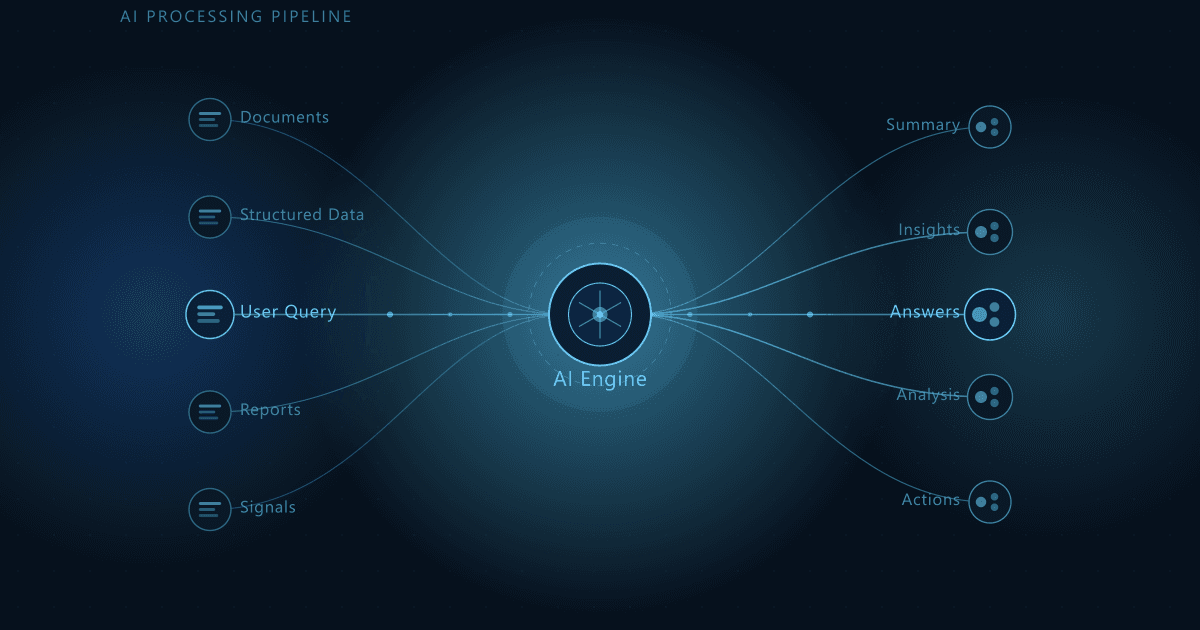
Chatbots are one visible expression of AI, but they are not the full picture. Many businesses explore AI through conversational interfaces because they are easy to understand, easy to demo, and easy to position. That does not mean they are always the highest-value implementation path.
In many organizations, the strongest return from AI comes from workflow integration. That might mean accelerating internal research, helping teams classify incoming information, generating structured first drafts, or reducing repetitive handling of known patterns. These uses are less theatrical than a public chatbot, but often more valuable.
The reason is simple. Businesses benefit when AI reduces friction in places that already matter. If a workflow is slow, repetitive, expensive, or bottlenecked by knowledge access, AI can become a practical multiplier. The focus should be on utility, trust, and system fit, not novelty.
One useful framing is to treat AI as a capability layer rather than a product feature. When AI is positioned as an internal capability, teams can ask sharper questions: Where does manual judgment create bottlenecks? Where is information access slow? Where does pattern recognition or language generation add real value? These questions point toward integrations that improve how work gets done, not just how it appears from the outside.
Data readiness is often the hidden constraint. Many AI integration efforts stall not because the technology is wrong but because the underlying data is unstructured, inconsistent, or poorly maintained. Before investing in a complex model, it is worth asking whether the organization has the data quality to support reliable outputs. The most common reason AI projects underdeliver is not model capability - it is data quality.
The human side of integration matters as much as the technical side. AI tools that require users to learn entirely new workflows tend to see low adoption regardless of their capabilities. The most successful integrations are designed around existing behavior - surfacing information in tools teams already use, automating steps that were previously manual without forcing new interfaces. Adoption is not separate from product design.
Good AI integration also requires restraint. Not every process needs a model in the loop. The strongest implementations are usually clear about boundaries, quality expectations, and failure handling. They support human decisions instead of pretending to replace them everywhere.
Evaluation and feedback loops are also undervalued. An AI model that works well in testing can degrade over time as the underlying patterns shift. Building in lightweight monitoring, reviewing outputs periodically, and creating mechanisms for users to flag poor results is what keeps an integration trustworthy over the long term. AI systems should not be deployed and forgotten.
That is why AI strategy should begin with workflow analysis, not interface excitement. Businesses that identify specific friction points, build targeted solutions, measure the impact, and iterate get the most from AI. That discipline produces systems that actually change how the business operates - which is where the durable value lives.
Continue with adjacent thinking.
Related articles are selected by category alignment first, then by overlapping tags and editorial fit.
AI Agents Are Not the Problem. Deployment Is.
Every major company is racing to deploy AI agents. Most will sit idle within six months. The failure is not technical.
Choosing the Right AI Model for Business Integration
The best AI model for a business use case is rarely the most powerful one. It is the one that fits the workflow, the data, and the reliability requirement.
Practical AI Governance for Companies Moving Beyond Experiments
AI governance becomes real when teams need clearer control over data, usage boundaries, review, and operational responsibility.
Contact
If this perspective matches a live delivery problem, email the context and we will respond with a clear next step.
Email info@cylunor.com. We review the context, confirm fit, and respond within one business day with either follow-up questions or a clear next step.