

Building Custom AI Tools That Teams Actually Adopt
The hardest part of building custom AI tools is not the model. It is designing something that fits naturally into how teams already work.
AI tooling, product design, and internal systems
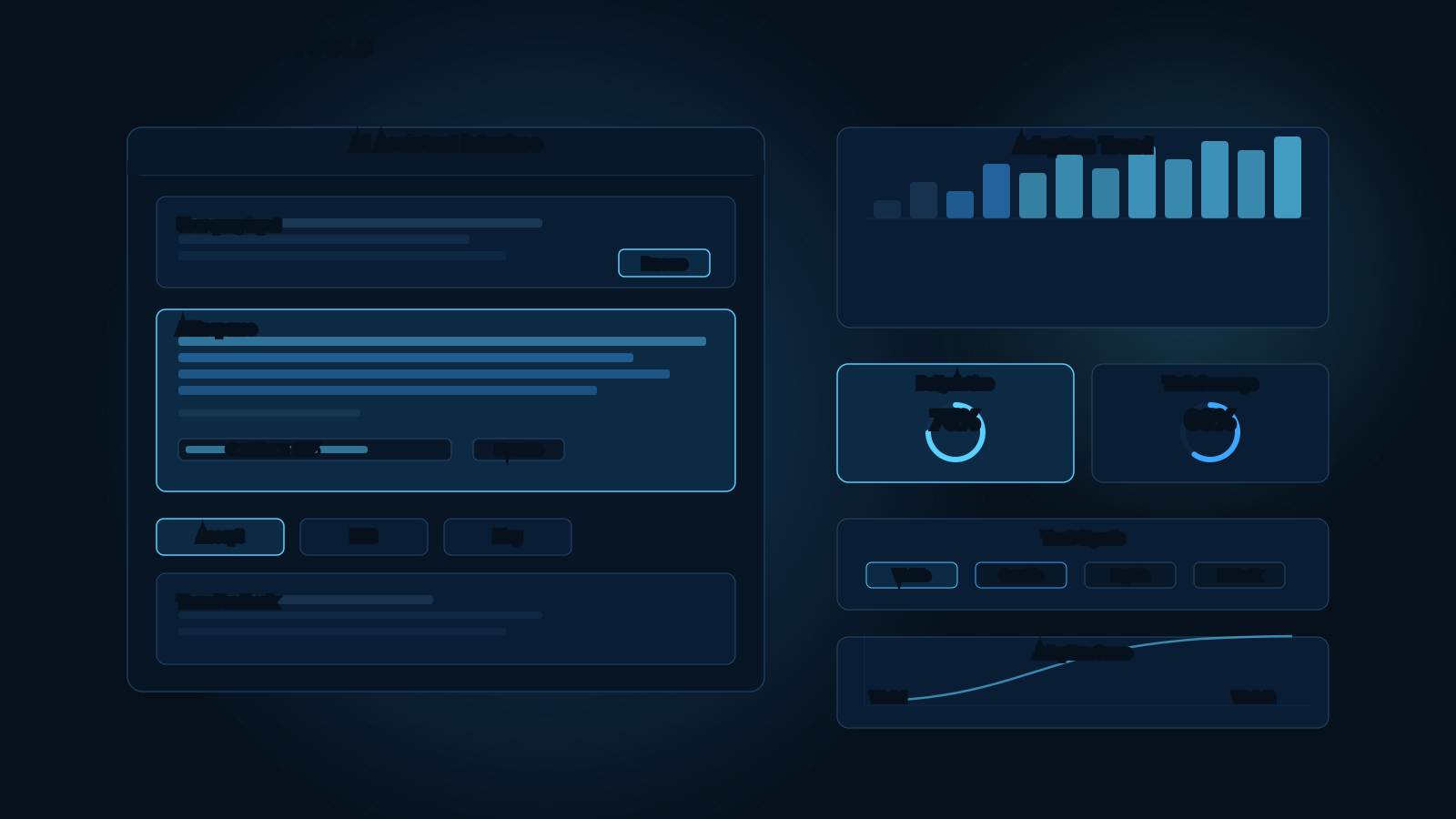
Many custom AI tools fail not because the technology is wrong but because adoption never reaches a useful threshold. Teams are given a new interface, a new workflow step, or a new dashboard that requires behavior change - and the tool quietly gets ignored.
The most successful custom AI tools are designed around existing behavior. They surface information where teams already look, automate steps that were previously manual without forcing new habits, and produce outputs in formats that fit current processes. Adoption is a design problem, not a training problem.
Trust is the other critical factor. Teams need to understand what the tool does, when it might be wrong, and what to do when the output is uncertain. Tools that provide confidence signals, allow easy override, and make their reasoning visible earn trust faster than tools that present results as black-box answers.
Building for adoption also means starting small. A tool that handles one well-defined task reliably is more valuable than a general-purpose assistant that tries to do everything. Focused scope creates clarity, and clarity creates usage. Once a team trusts a tool in one context, expanding its role becomes much easier.
Continue with adjacent thinking.
Related articles are selected by category alignment first, then by overlapping tags and editorial fit.
AI Integration Beyond Chatbots
The most valuable AI work often happens behind the interface, inside the workflow itself.
AI Agents Are Not the Problem. Deployment Is.
Every major company is racing to deploy AI agents. Most will sit idle within six months. The failure is not technical.
Practical AI Governance for Companies Moving Beyond Experiments
AI governance becomes real when teams need clearer control over data, usage boundaries, review, and operational responsibility.
Contact
If this perspective matches a live delivery problem, email the context and we will respond with a clear next step.
Email info@cylunor.com. We review the context, confirm fit, and respond within one business day with either follow-up questions or a clear next step.