

Why Modern Businesses Need Scalable Software Systems
Scalability is not only a traffic concern. It is an organizational concern that shapes how fast a business can move.
Software architecture, internal platforms, and scalable delivery
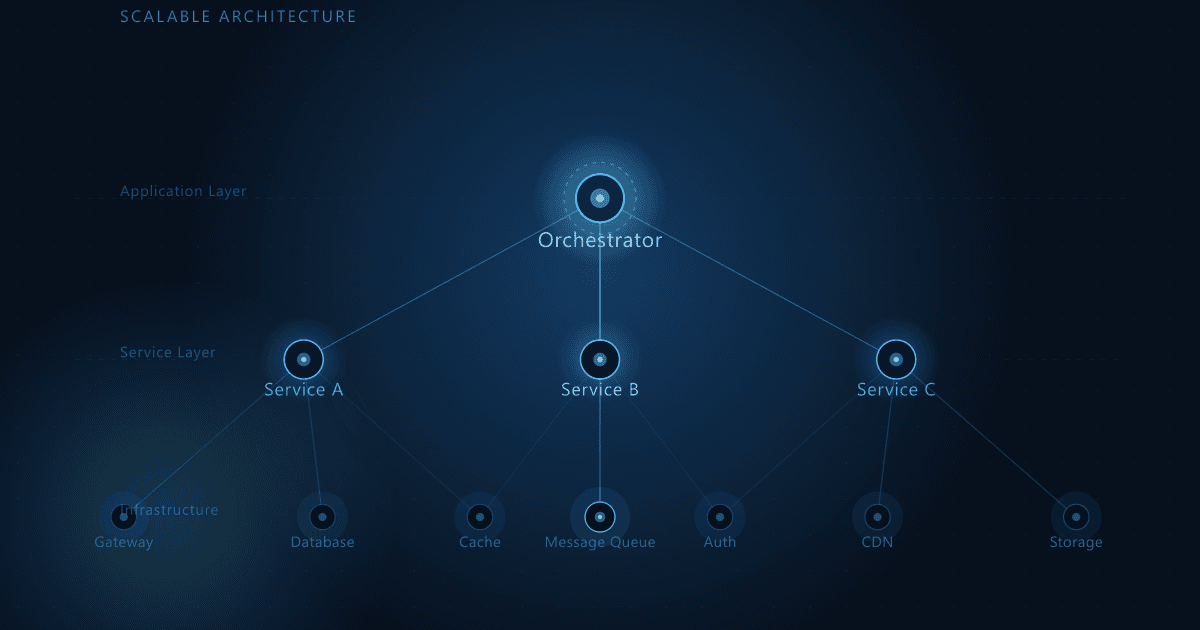
Scalability is often misunderstood as a concern that only appears when a platform reaches large traffic numbers. In practice, the need for scalable systems starts much earlier. It begins the moment a business depends on software to coordinate work, serve customers, or create visibility across operations.
A system that cannot scale is not only one that struggles under load. It is also one that becomes harder to change, harder to understand, and harder to trust. For growing businesses, that kind of friction turns into slower delivery, more expensive fixes, and weaker confidence in digital initiatives.
The real value of scalable software is structural. Good systems create room for change. They let teams add features without destabilizing the entire product. They let operations improve without reworking everything from scratch. They also create the kind of internal clarity that makes strategic planning more realistic.
Scalability starts with architecture, but it does not end there. It includes naming, boundaries, ownership, observability, and the discipline to avoid short-term patches becoming permanent foundations. Businesses that take software seriously benefit from systems that can support both current delivery and future evolution.
The distinction between scalable and non-scalable systems often becomes visible at the wrong time. A product that worked at fifty users may start to fracture at five hundred. A codebase that felt manageable with three developers becomes a coordination problem with eight. Scalability is not a feature to add later. It is a structural quality that has to be designed in from the beginning or retrofitted at significant cost.
Architecture is the most direct lever. Systems with clear separation between components - where data, business logic, and presentation are treated as distinct concerns - adapt more easily to change. When a new requirement arrives, the team can isolate the relevant part, make the change, and verify it without affecting everything else. That isolation is what makes growth tractable.
Database design is another underestimated factor. Many systems start with relational structures that made sense early but create bottlenecks as volume grows. Understanding query patterns, indexing strategies, and when to introduce caching or read replicas is not advanced engineering. It is basic hygiene for any system expected to operate at business scale.
The organizational dimension of scalability is equally important. Teams working on systems they do not fully understand slow down over time. Documentation, clear naming conventions, and consistent patterns reduce the cognitive overhead of working in a codebase. A system that is technically scalable but operationally opaque will still limit delivery speed.
Observability is the layer that makes scalability maintainable. Systems that surface meaningful signals - response times, error rates, queue depths, database query performance - give teams the information they need to act before problems become incidents. Building observability in from the start is far less expensive than retrofitting it after the first serious production issue.
This is why software development should not be approached as isolated implementation. It should be treated as infrastructure for the business itself. When systems are designed with maintainability and growth in mind, the result is not only technical resilience. It is strategic flexibility - the ability for a business to move with confidence as its scale and ambitions grow.
Continue with adjacent thinking.
Related articles are selected by category alignment first, then by overlapping tags and editorial fit.
When Internal Tooling Becomes a Growth Requirement
Internal tools matter when spreadsheets, workarounds, and fragmented systems start slowing decisions and delivery.
Building Trust Through Technical Clarity
Technical clarity is one of the fastest ways a company can build trust with sophisticated clients.
Why Written Scope Still Protects Digital Projects
Written scope is not administrative overhead. It is one of the most practical trust tools in digital delivery.
Contact
If this perspective matches a live delivery problem, email the context and we will respond with a clear next step.
Email info@cylunor.com. We review the context, confirm fit, and respond within one business day with either follow-up questions or a clear next step.