

Building Trust Through Technical Clarity
Technical clarity is one of the fastest ways a company can build trust with sophisticated clients.
Technical communication, delivery structure, and trust-building
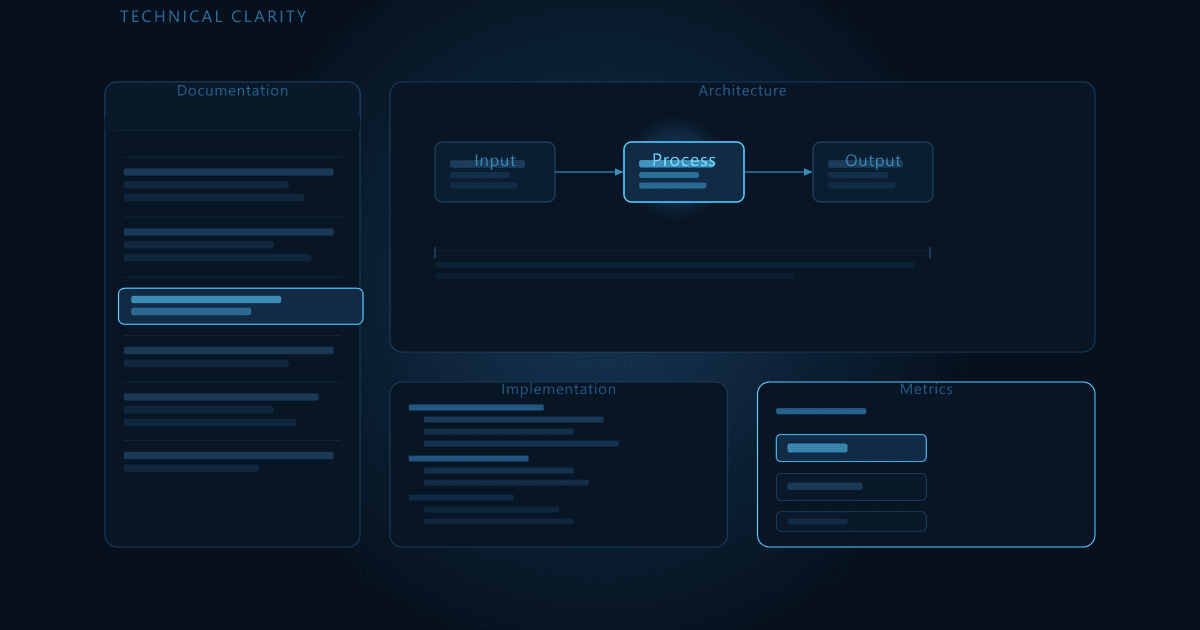
Trust is often discussed as a relational quality, but in technical businesses it is also an operational one. Clients trust companies that can explain what they are doing, why they are doing it, and how decisions connect to outcomes.
Technical clarity does not mean exposing every implementation detail. It means communicating with enough structure that the other side can follow the logic. When teams describe systems, tradeoffs, and delivery choices clearly, they reduce uncertainty. That matters even more in high-stakes or complex projects.
Many companies underestimate how much confidence they lose through vague language. Generic claims about innovation or quality do not create the same trust as precise explanations of architecture, workflow impact, or delivery discipline. Clarity feels more credible because it is more accountable.
Documentation is one of the least glamorous but most trust-relevant artifacts a technical team produces. When a client can understand what was built, why decisions were made, and how the system is expected to behave, they enter the relationship with a stronger foundation. Documentation that is clear, current, and appropriately detailed signals that the team takes accountability seriously - not just for delivery, but for the ongoing health of the work.
Communication during delivery matters as much as the quality of the final output. Teams that surface issues early, explain tradeoffs clearly, and share progress in terms the client can understand develop trust faster than teams that go quiet and deliver at the deadline. Transparency about complexity is not a weakness. It is evidence of professional maturity.
Technical clarity also shapes internal culture. Teams that explain their decisions, write readable code, and maintain coherent systems create environments where new members can contribute quickly and existing members can work with confidence. Opaque systems and undocumented decisions create fragility that eventually shows up as delivery problems.
For client-facing businesses, the clarity of technical communication is a competitive signal. A company that can explain its architecture, its testing approach, and its delivery process convincingly is easier to trust with complex or high-stakes work. Clients making significant technical investments want evidence that the team they are working with understands not just how to build, but how to communicate what they are building and why.
This principle applies to digital presence as well as client work. A clear website communicates maturity. It shows that the company knows its own strengths, understands its audience, and can express complex capability without hiding behind noise.
That is why technical clarity should be treated as part of the product. It shapes first impressions, strengthens collaboration, and gives both sides a clearer foundation to build on. Teams that communicate clearly accumulate trust - and that trust reduces friction in decision-making, creates more candid conversations about risk, and makes clients more likely to return and refer others.
Workflow Automation for Operations Efficiency
An automation layer that reduced repetitive admin work and made operational handoffs more reliable.
- Handoff errors eliminated
- Consistent process delivery at scale
Premium Digital Presence for a Modern Consultancy
A refined web experience that aligned a consultancy's digital presence with its strategic positioning.
- Clearer service positioning
- Reduced bounce from key landing pages
Continue with adjacent thinking.
Related articles are selected by category alignment first, then by overlapping tags and editorial fit.
Why Written Scope Still Protects Digital Projects
Written scope is not administrative overhead. It is one of the most practical trust tools in digital delivery.
Why Modern Businesses Need Scalable Software Systems
Scalability is not only a traffic concern. It is an organizational concern that shapes how fast a business can move.
When Internal Tooling Becomes a Growth Requirement
Internal tools matter when spreadsheets, workarounds, and fragmented systems start slowing decisions and delivery.
Contact
If this perspective matches a live delivery problem, email the context and we will respond with a clear next step.
Email info@cylunor.com. We review the context, confirm fit, and respond within one business day with either follow-up questions or a clear next step.